
RF & Microwave
High-frequency electromagnetic simulation module in EMWORKS for antennas, filters, resonators, interconnects and other RF components.
.webp)
RF & MICROWAVES Overview
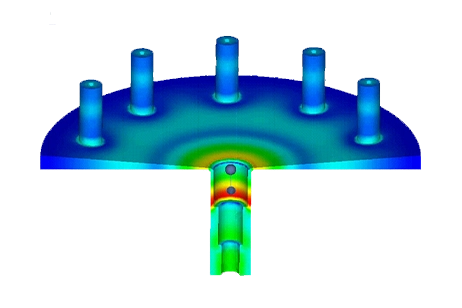
RF & MICROWAVES is the high-frequency module of EMWORKS. It is used to model electromagnetic wave behaviour in 3D and to evaluate quantities such as S-parameters, field distributions, resonant modes, radiation patterns and time-domain responses, including TDR for interconnects and transmission lines. When coupled with EMWORKS thermal solvers, RF losses can be used as heat sources to estimate temperature rise in high-power components and densely packed assemblies. Typical devices include antennas, filters, resonators, waveguides, connectors, transitions and high-speed interconnects where geometric details, material properties and thermal effects have a strong impact on performance.
RF & MICROWAVES Analysis Options
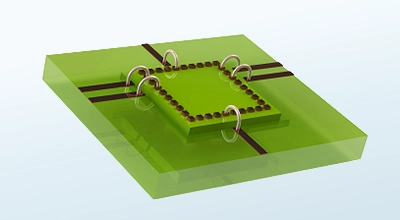
S-Parameters
Compute scattering parameters for circuits and components, including insertion loss, return loss and isolation. Use these results to assess matching, bandwidth and overall RF performance.
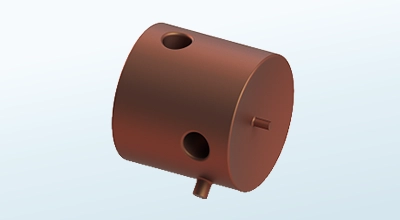
Resonance
Identify resonant frequencies and field distributions in cavities, resonators and filter structures. This helps set dimensions and materials to achieve the required frequency response.
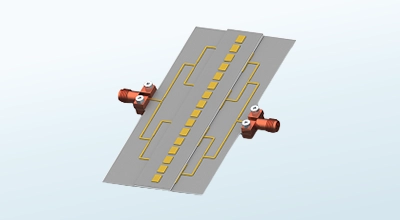
Antennas
Evaluate radiation patterns, gain, efficiency and impedance of antennas and arrays. Study the effect of ground planes, radomes and nearby structures on antenna performance.
Time Domain
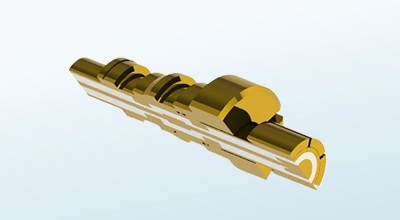
Analyze transient behaviour in interconnects and components, including reflections from discontinuities, crosstalk and dispersion in high-speed signal paths.
Multiphysics Coupling
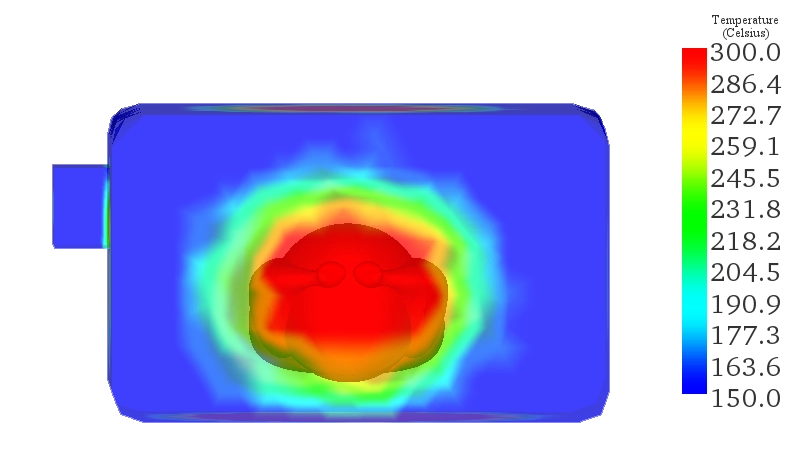
In many RF applications, losses lead to temperature rise and changes in performance. RF & MICROWAVES supports coupling with thermal analysis in EMWORKS.
Thermal Coupling
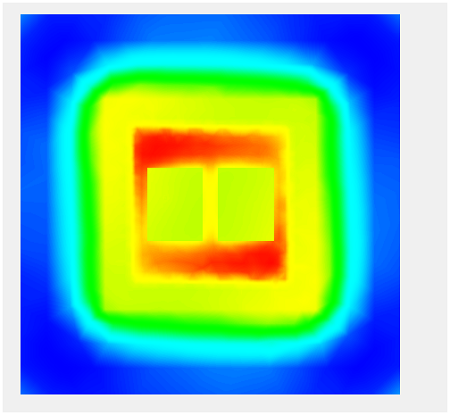
RF power losses computed in electromagnetic studies can be transferred to thermal solvers to estimate temperature distribution and identify regions at risk of overheating or material limits. This is useful for high-power components, tightly packed boards and systems where cooling is constrained.
Applications of RF & MICROWAVES
Chip, Package, Board Systems
Connectors and Transitions
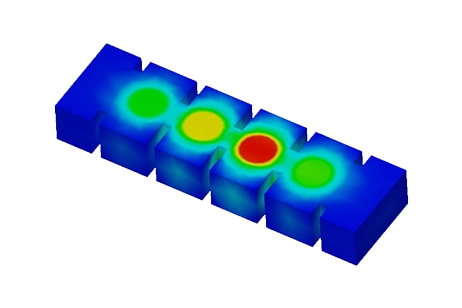
Electro-Thermal
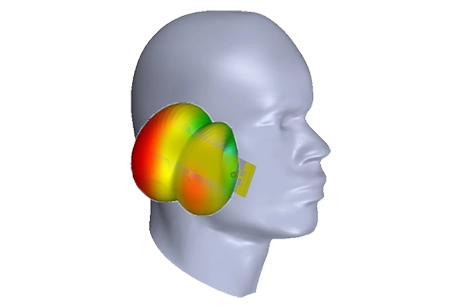
EM Exposure
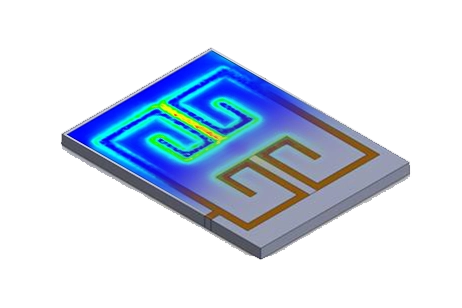
Filters
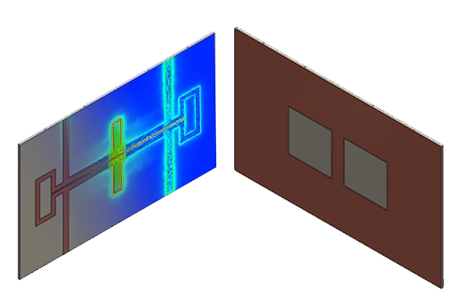
Passive Components
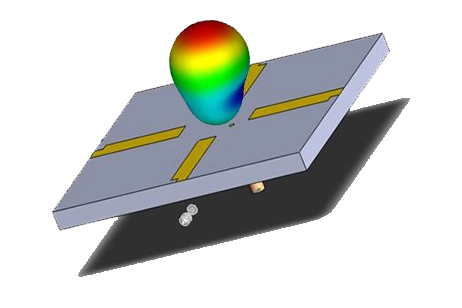
Planar-Printed Antennas
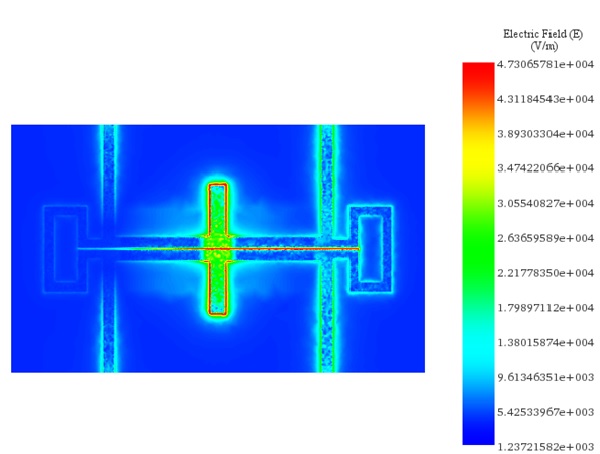
Printed Circuit Boards (PCBs)
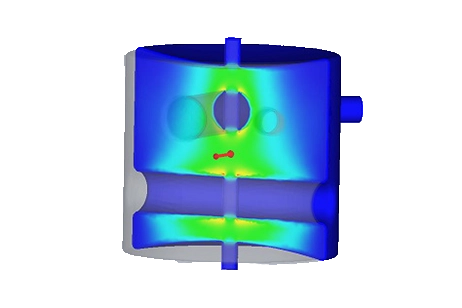
Resonators
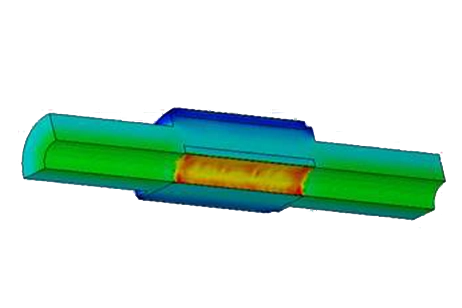
Transmission Lines
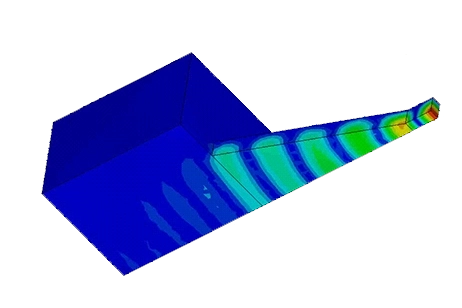
Waveguide Antennas
RF & Microwave FAQs
EMWORKS RF & MICROWAVE is EMWORKS high-frequency finite-element solver for 3D electromagnetic wave simulation. It's used to design and validate antennas, filters, resonators, waveguides, connectors, and high-speed interconnects, computing S-parameters, field distributions, resonant modes, radiation patterns, and time-domain responses such as TDR. For faster setup, users can optionally run a ports-only solution to characterize port behavior before committing to a full-structure solve.
Yes. RF power losses computed in an electromagnetic study can be passed directly to EMWORKS thermal solvers as heat sources, letting engineers estimate temperature rise in high-power components and densely packed RF assemblies without leaving the environment. S-parameters and other circuit-level parameters extracted from the 3D model can also be exported to popular circuit simulators, so the electromagnetic behavior of a component can be verified in a full system-level circuit design.
EMWORKS RF & MICROWAVE couples with EMWORKS thermal and structural analysis tools, and with EMAG for devices that combine low-frequency and high-frequency behavior in the same assembly. Field results and losses carry over directly as inputs to those coupled studies on the same geometry.
Models can be built natively in EMWORKS integrated CAD, powered by Autodesk Inventor, or brought in from external CAD systems with assembly structure intact. Modeling, solving, and post-processing all stay in one environment, so there's no version drift between the CAD file and the simulation. Parametric geometry supports quick tuning of dimensions, feed positions, and material properties.
EMWORKS RF & MICROWAVE evaluates gain, radiation patterns, efficiency, and impedance for antennas and arrays, and extracts S-parameters, Q-factors, and pass-band response for filters and resonators. Wideband frequency sweeps and parametric studies let engineers compare design variants and catch detuning caused by nearby structures such as radomes, housings, or PCBs before prototyping.
EMWORKS RF & MICROWAVE covers a wide span of high-frequency electromagnetic problems, including:
- Antennas & Arrays: patches, horns, dipoles, monopoles, helicals, conformal antennas
- RF Passive Components: filters, couplers, dividers, crossovers, resonators
- High-Speed Interconnects: connectors, transitions, waveguides, transmission lines
Because CAD, electromagnetic simulation, and thermal coupling live in a single environment, EMWORKS RF & MICROWAVE shortens the loop between a design change and a validated result. That means fewer physical prototypes, earlier detection of detuning or overheating risk, and faster comparison of design alternatives across a frequency sweep. In line with EMWORKS focus on accessible electromagnetic simulation, the bundled CAD-plus-solver license puts full-wave 3D analysis within reach of smaller engineering teams, not just large organizations with dedicated simulation budgets.
EMWORKS RF & MICROWAVE ships as part of the EMWORKS software suite and is available as a free trial through the EMWorks website.
Why teams use RF & MICROWAVES
Design validation before hardware
To check whether the chosen geometry, stack-up and materials deliver the required S-parameters, bandwidth, matching and radiation characteristics at the target frequencies.
Understanding fields in complex 3D structures
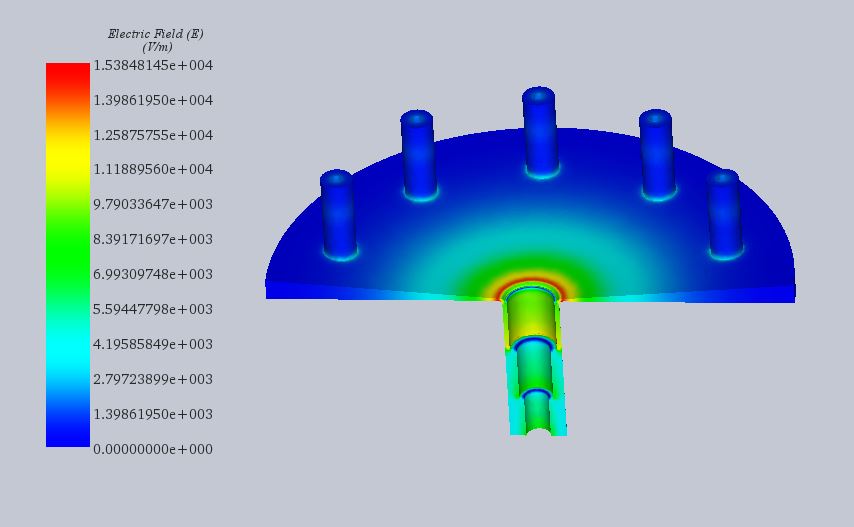
To see where fields, currents and losses are concentrated in connectors, transitions, packages, enclosures and waveguide structures, and how changes in geometry affect them.
Troubleshooting and refinement
To investigate unexpected resonances, coupling paths, EMI/EMC issues or sensitivity to manufacturing tolerances that are hard to isolate from measurements alone.
Supporting layout and packaging decisions
To evaluate how PCB routing, via placement, shielding, grounding and housing details influence performance and interference between nearby circuits or antennas.
Complementing circuit simulation and measurement
To provide 3D field-based results that sit alongside circuit-level simulation and lab measurements, helping to explain observed behaviour and guide design changes.
Evaluate RF & MICROWAVES on your designs
If you work with RF, microwave or high-speed components and need field-level simulation in addition to circuit tools and measurements, you can evaluate RF & MICROWAVES as part of EMWORKS.
A short trial on one or two representative models is usually enough to see whether the module fits your workflows and accuracy requirements.