

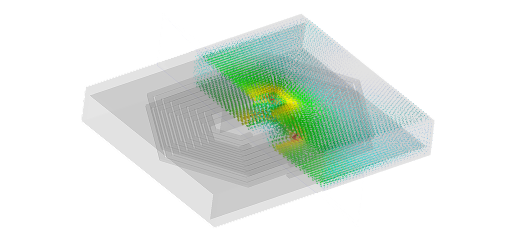
Planar transformers are now a standard choice in electric vehicle power electronics, where a low profile, repeatable layered construction, and predictable thermal behavior matter as much as raw electrical performance. This session covers where they fit — isolated DC-DC converters, onboard chargers, bidirectional power stages, and fast-charging architectures — and then builds and analyzes one end to end.
The first part deals with the design constraints specific to planar construction: layered copper and foil windings, interleaving, core geometry, and the leakage and proximity effects that dominate at the switching frequencies used in automotive converters.
The second part is a complete simulation of an isolated planar transformer for an automotive DC-DC converter, run live in EMWORKS:
- Building the geometry and modeling the layered windings directly in the tool
- Assigning core and conductor materials
- Setting up excitation and the electromagnetic solver
- Extracting leakage inductance
- Visualizing flux distribution and field results
The emphasis throughout is on how those results feed back into physical design decisions — winding layout, core selection, and the layer stack that actually gets fabricated — so the model drives the build instead of just describing it after the fact.
Relevant for power electronics designers, electrical engineers, and researchers working on EV magnetics, converter design, and electromagnetic simulation.