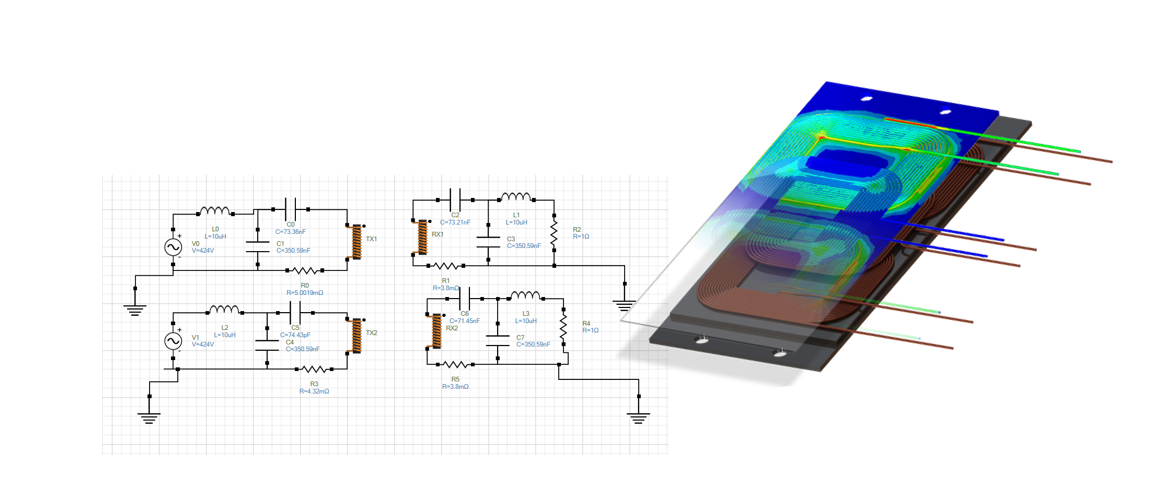

Field-Circuit Co-Simulation

Two-Way Coupling for Accurate Transient and AC Analysis

Circuit Coupling in EMWORKS

Circuit coupling integrates the 3D electromagnetic field model with an electrical schematic for accurate system-level simulation.

How Coupled Simulation Works

During the solution, two solvers interact continuously:

  • Electromagnetic Solver: Computes flux linkage, induced voltage, current distribution, and power losses in the 3D geometry.

  • Circuit Solver: Uses these electromagnetic values as port quantities within the schematic. Currents and voltages from the circuit then become boundary conditions for the next electromagnetic calculation.

This exchange creates a two-way interaction, capturing real-world effects like saturation, back-EMF, and non-linear inductance.

Simulation Workflow

  • Define 3D EM Model: Assign materials, coil and conductor regions, sources, and boundary conditions to the geometry.

  • Assign Circuit Ports: Coils or conductive paths in the 3D geometry are defined as electrical terminals. These terminals exchange voltage and current with the circuit model.

  • Build External Circuit: Create the schematic using sources, loads, passive elements, switching devices, and control elements. Connect the electromagnetic ports to the appropriate nodes in the circuit.

  • Solve Coupled Problem:

    • Time-Domain: The EM solver and circuit solver exchange values at each time step (Transient analysis).

    • Frequency-Domain: The EM solver provides impedance or port parameters for AC analysis.

  • Postprocess Results: Review both circuit and field data simultaneously.

Key Capabilities

  • Two-Way Field–Circuit Interaction: Circuit conditions drive the EM model, while EM quantities (like induced voltage) feed back into the circuit.

  • Analysis Support: Supports Transient (time-domain) analysis for motors, converters, and switching systems, and Steady-State AC (frequency-domain) analysis for impedance and resonance studies.

  • Winding and Port Representation: Coils, conductors, and terminals in the 3D model are represented as electrical ports with defined current and voltage.

  • Multiphysics Integration: Circuit coupling can be combined with other studies (motion, thermal, or structural) to analyze fully interacting physical behaviors.

  • Typical Applications

    Circuit coupling is required when the electromagnetic device performance depends directly on its connected electrical system:

  • Transformers and Inductors: Analysis of magnetizing current, leakage inductance, and core losses under connection to rectifiers or switching circuits.

  • Motors and Generators: Study of back-EMF, torque, and transient startup when windings are connected to inverters, drives, or controllers.

  • Wireless Power Systems: Simulation of resonant tank circuits and compensation networks linked to transmitter/receiver coils to determine efficiency and sensitivity.

  • Inductive Sensors and Sensing Coils: Calculation of output voltage or current from pickup coils and sensing elements based on the electromagnetic field they measure.

Results and Data Output

Coupled simulations provide a complete set of circuit and field results:

  • Circuit Quantities: Voltage, current, power flow, losses, and efficiency versus time or frequency.

  • Field Quantities: Fields, losses (eddy current, hysteresis, copper), and flux in the electromagnetic model.

By visiting or using this website you agree to the storing of cookies on your device to enhance site navigation, analyze site usage, and assist in our marketing efforts. View cookies details.